
#8 The five dysfunctions of a team
⏱ Approx. 60 - 90 minutes
𐀪 4-6 people
❔ Encourage the team to make a plan for future evaluations of the five dysfunctions or to include some of the elements and evaluations into the group contract.
background
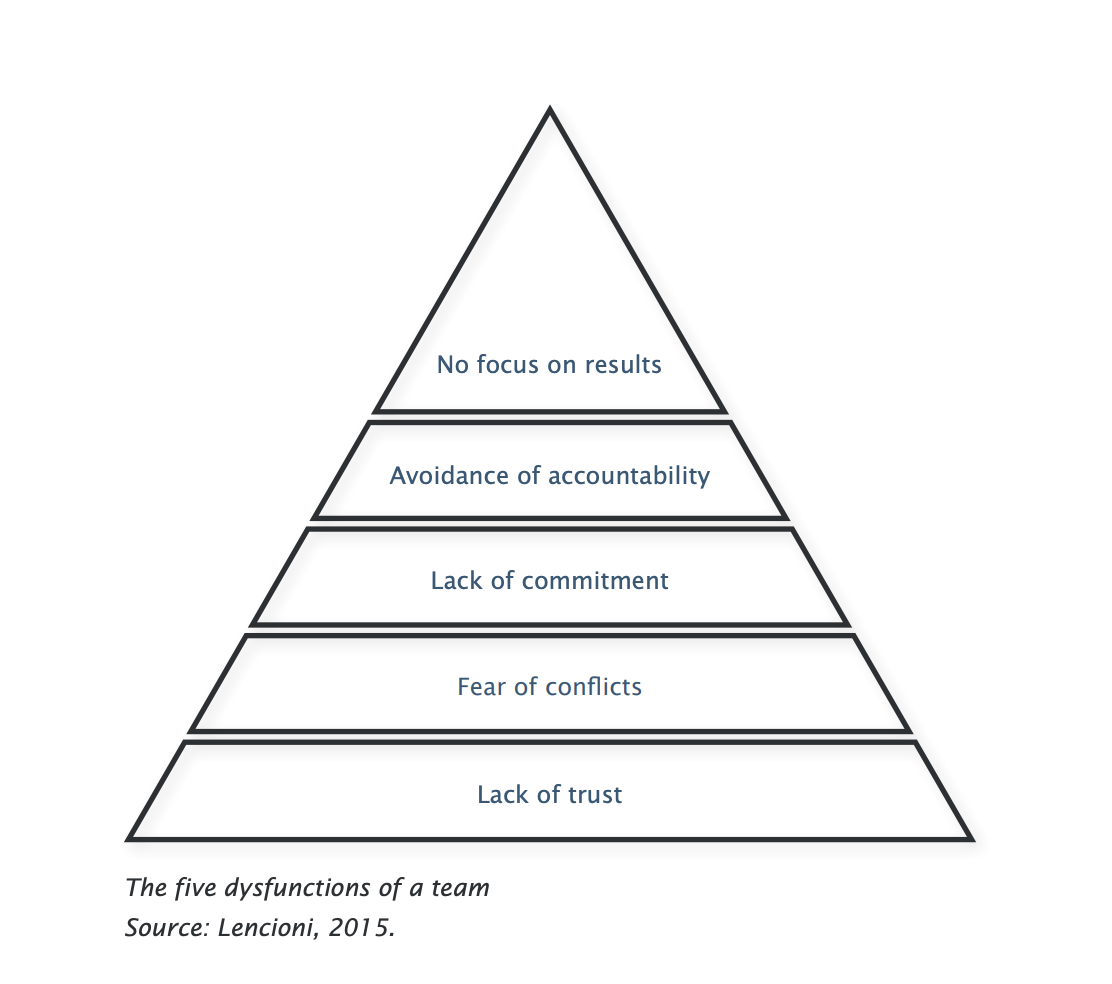
The five dysfunctions of a team indicate the five most common causes of teamwork problems.
These are:
1. Lack of trust
2. Fear of conflicts
3. Lack of commitment
4. Avoidance of accountability
5. No focus on results
Lack of trust:
Trust between team members is pivotal for teamwork. Lack of trust is often seen in lack of courage to show vulnerability and openness about own mistakes and weaknesses.
Fear of conflicts:
If the team members do not trust each other, it makes them unable to engage in committed discussions and develop ideas. This is necessary to ensure development within the team.
Lack of commitment:
If the team does not have open discussions, it will make the team unable to commit to other’s ideas and decisions.
Avoidance of accountability:
Without commitment to a clear action plan, even the most focused and energetic team members will often hesitate to criticise actions or behavioural patterns, which are not appropriate in relation to the group contract or plan.
No focus on results:
If the team members fail to keep each other responsible, there will be too little focus on results. Lack of focus and attention to results occur when team members prioritise their individual needs higher than the team’s common purpose and goals.
purpose
By introducing and working with the levels of Lencioni’s model, the goal is to overcome the five dysfunctions and create the perfect team. Lencioni’s words about a perfect team are as follows: ”A perfect team is able to work together, ask each other for help, pull on each other’s competences, embrace faults and limitations, make qualified decisions and accomplish more in less time.
procedure
Each team member will individually evaluate the team based on the five dysfunctions by answering the following questions: Confidence – if you were to describe the current level of trust within the team on a scale from 1-5, where 5 is best, which number and words would you use?
This process is used for the following five levels. When each team member has reflected on the five levels/questions, he or she presents it for the team’s assessment. It is the facilitator’s responsibility (or team members’) to ensure that the team discusses and reflects openly and without prejudice to the individual member’s evaluation of the team on the five levels.
example
Practical matters
Make plenty of time for this exercise and put an effort into creating a comfortable and cosy environment in a room reserved for only one group. Coffee and cake could be an option. The prerequisites for the good teamwork – and that the five dysfunctions are not overwhelming – should be discussed in the team on a regular basis. The five dysfunctions of a team form a good basis for working with some of the other tools in this booklet, such as ”Team operating models” and ”conflict matrix”. Several of the tools complement each other.
Further information
The model of the five dysfunctions is developed by the American author and consultant Patrick Lencioni. It is part of the book ”The 5 Dysfunctions of a Team”.