step
Dit afsnit går her
1
Dit afsnit går her
step
Dit afsnit går her
2
Dit afsnit går her
step
Dit afsnit går her
3
Dit afsnit går her
step
Dit afsnit går her
4
Dit afsnit går her
Toolbox for teamwork
The structure of the toolbook is based on the different processes within teamwork and starts from the formation of a team to the dissolution of the team. The toolbook is applicable for teamwork in both companies and educational institutions.
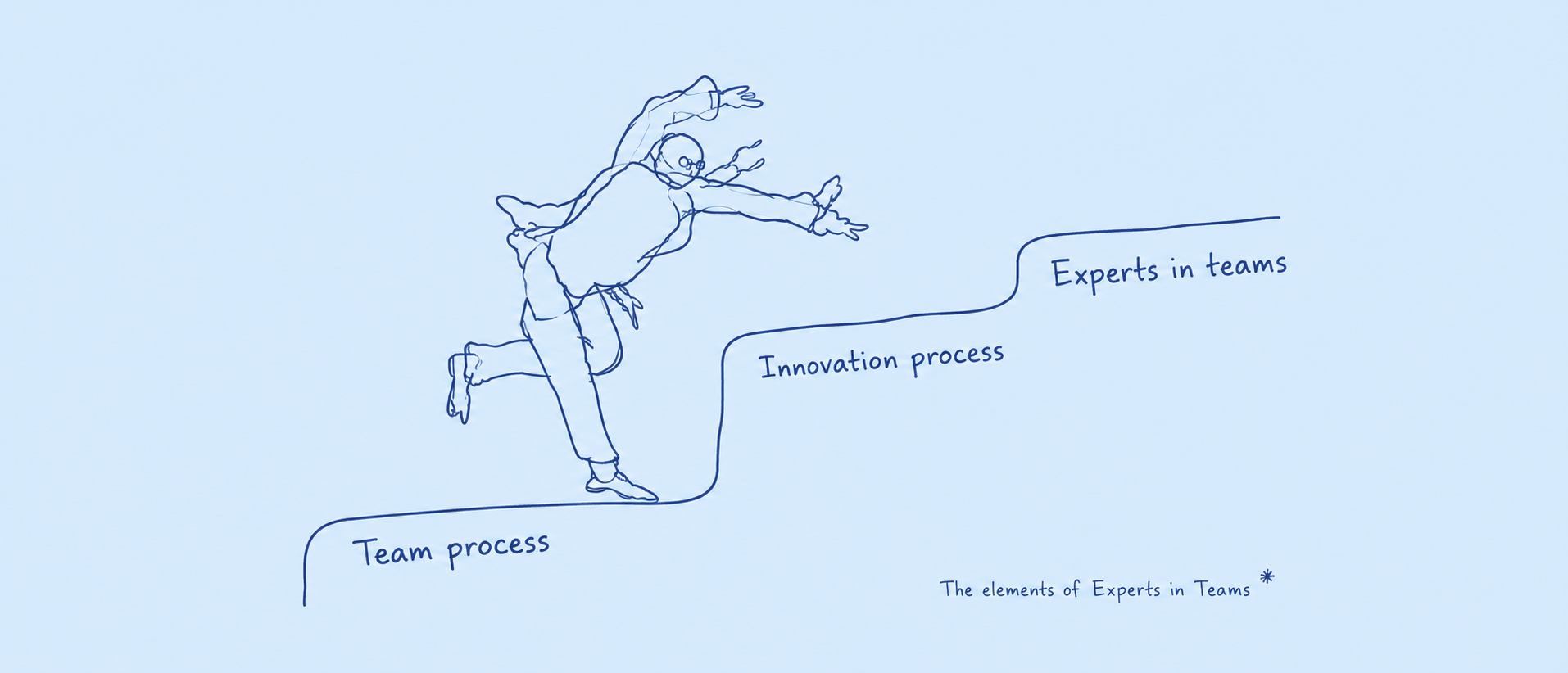
Step 3 concerns reflection on teamwork and is related to the figure’s top level “Experts in Teams” since reflection is fundamental to becoming an expert in teamwork.
The toolbook has four steps that reflect the Experts in Teams figure beneath. Step 1 and 3 deal with the team process and contain tools for forming teams, teambuilding and teamwork facilitation.
Step 4 concerns the ‘Innovation Process’ and provides tools for idea creation, selection and visualisation processes.
step 1
team formation
This section concerns the element of ”Team Processes” in the Experts in Teams figure and contains tools and exercises for team formation and teambuilding. Team formation is the foundation for starting a team process and collaboration, and team members’ skills and competencies are at the same time the resource base for solving a specific task.
Teambuilding is a crucial starting point for the coming team collaboration and ensures that the team members get to know each other, build trust and trust each other. Through this, the individual professional resources and competencies presented within the team become usable and provide both energy and synergy.
Click here and find the specific tools developed for step 1: team formation and team building.
step 2
facilitating teamwork
This section concerns the element ‘Team processes’ in the Experts in Teams figure and contains tools and exercises to facilitate teamwork. Teamwork is a discipline that is possible to learn. However, teamwork is not always running smoothly. Therefore, different tools and exercises are necessary. They are useful for facilitators (for example lecturers) or team members to ensure good teamwork.
The tools and exercises allow the team to reflect upon what is going on in the team right now. Then it is possible to create awareness of the elements of teamwork, and hence the opportunity to optimise teamwork.
Click here and find the specific tools developed for step 2: facilitating teamwork.
step 3
reflecting on teamwork
The ability to reflect on teamwork is crucial for learning and becoming an ”expert in teamwork” according to the top level of the Experts in Teams figure. Therefore, this section contains tools and exercises for reflection. Reflecting on individual and collective experiences is a way to gain both individual and collective learning. Through this, the individual team member gets better and better at working in teams and ultimately masters it as a personal competence.
Reflection is difficult. However, the tools and exercises may help the team to frame the reflection work. Reflection implies a way to discuss the teamwork in general, what went well and where there is room for improvement.
Click here and find the specific tools developed for step 3: reflection on teamwork.
step 4
innovation
This section concerns the middle part of the Experts in the Teams figure, the ‘Innovation Process’, and contains tools and exercises for the facilitation of an innovation process. This process is about getting, developing and choosing ideas that can be used as a solution to a specific innovation challenge.
Typically, it has been these kinds of challenges or tasks that we have used to train and develop teamwork skills and thus helped students to become experts in teamwork.
The tools are relevant for facilitators (teachers) or team members when the task is within the field of innovation or when any task requires the creation and development of an idea.
Click here and find the specific tools developed for step 4: innovation.