#15 Learning loop
⏱ Approx. 1-2 hours
𐀪 4-6 people
❔ Place the team in a circle. Create a committed environment without tables and computers. This is very important for reflecting and learning together. The team should help each other to ask curious, wondering and investigating questions, since this helps to raise the level of trust and openness to each other. It is a good idea to have a tight timeframe, without getting too rigid. There must be room for both thoughts and goals of action.
▷ Watch video on www.expertsinteams.org
background
The learning loop model can be used for both reflection among the facilitators (teachers) on a team process or to reflect on own learning outcome (team members) in a team process.
purpose
Teams may need to reflect on the team process, what the team has learned and what should be done differently next time. The learning loop model enables you to reflect on the team process and the collaboration in a structured manner together with your team.
procedure
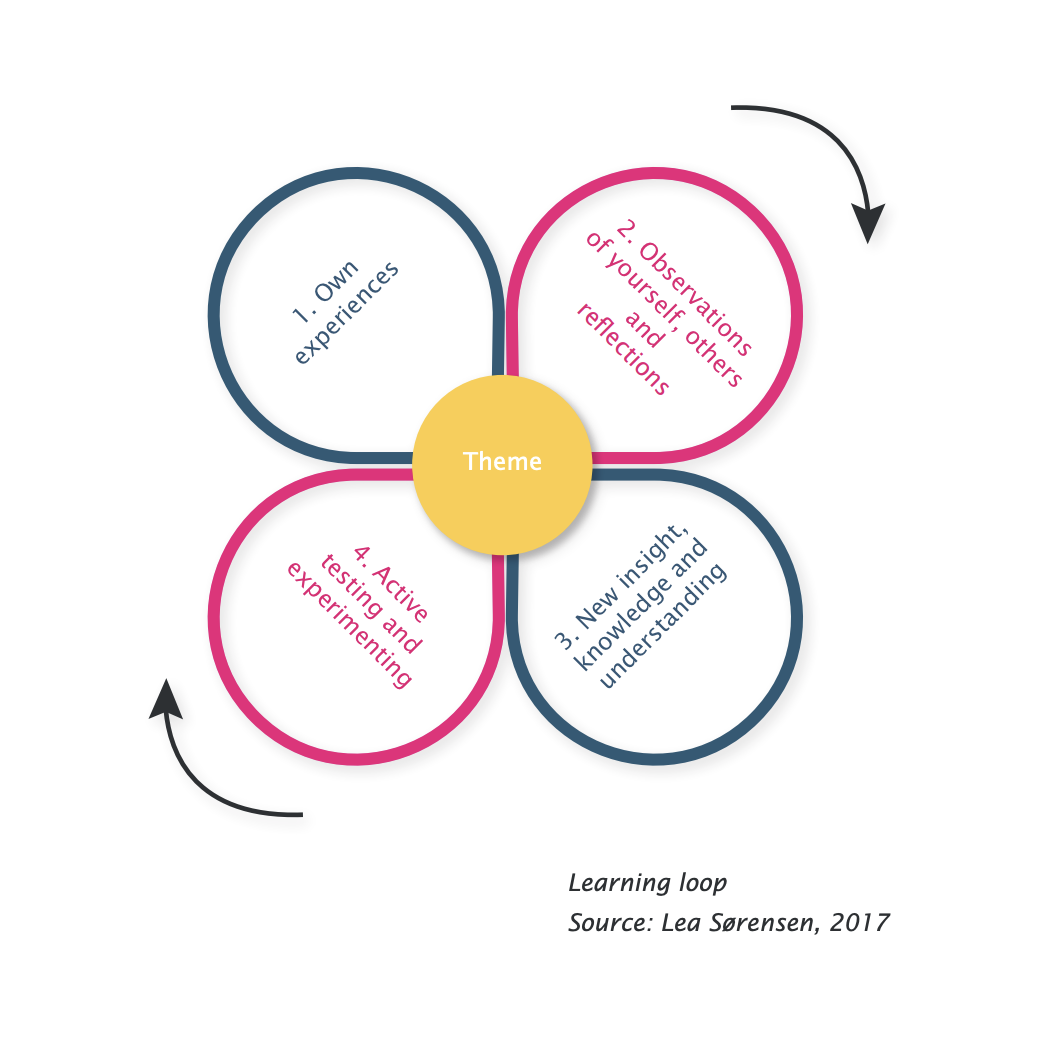
First, choose a theme or starting point for the reflection. In the example, the theme is ‘Facilitation in EiT’. The theme could also be cooperation, the quality of the professional level and so forth.The model consists of 4 phases,and it is important to dedicate the same amount of time for each phase and between each team member. All phases are equally important and each team member must have time to share his or her thoughts in each phase.
In the first phase, each team member shares his or hers experiences with the other team members. It is important that the other team members listen carefully.
The second phase concerns the sharing of observations, thoughts and reflections that may occur after listening to each other’s experience. Perhaps a member has experienced something that can help someone else in the team understand and discover the teamwork situations.
In phase three, the team reflects on the reflection. So here, new insights, knowledge and understandings are created. Have the team members met the reflections or problems in other situations? Are there any theories or concepts that can help explain and understand the reflections in phases one and two? How does the individual team member benefit from the group reflection in relation to the topic?
These considerations lead to phase four, where the collective reflections lead tospecific actions. What will each team member do differently next time? What experiments can the team make together? How can the team help and support each other with new actions?
practical matters
In EiT, both the facilitators and team members use the learning loop model to create reflection and new experiments. In order to produce the best possible outcome of this exercise, a recommendation is to find a facilitator, who can control time, help explain the different phases and ensure progress in the process. The team will be able to facilitate the learning loop process itself after practicing the process a few times.
Remove tables, computers, etc. and form a circle with chairs that allows everyone to see each other during the process. The focus of the reflection exercise may be written on flip chart paper. This can also be done for agreements and points of action in phase four. To complete the learning loop, the facilitator or one of the team members ensures that everyone gets to present what they have learned in the reflection session. After that, the facilitator can ask how the team members can help each other or what the individual needs help with in future team situations.
further information
Lea Sørensen, senior lecturer, BAAA, EiT 2017, developed the learning loop model.
example