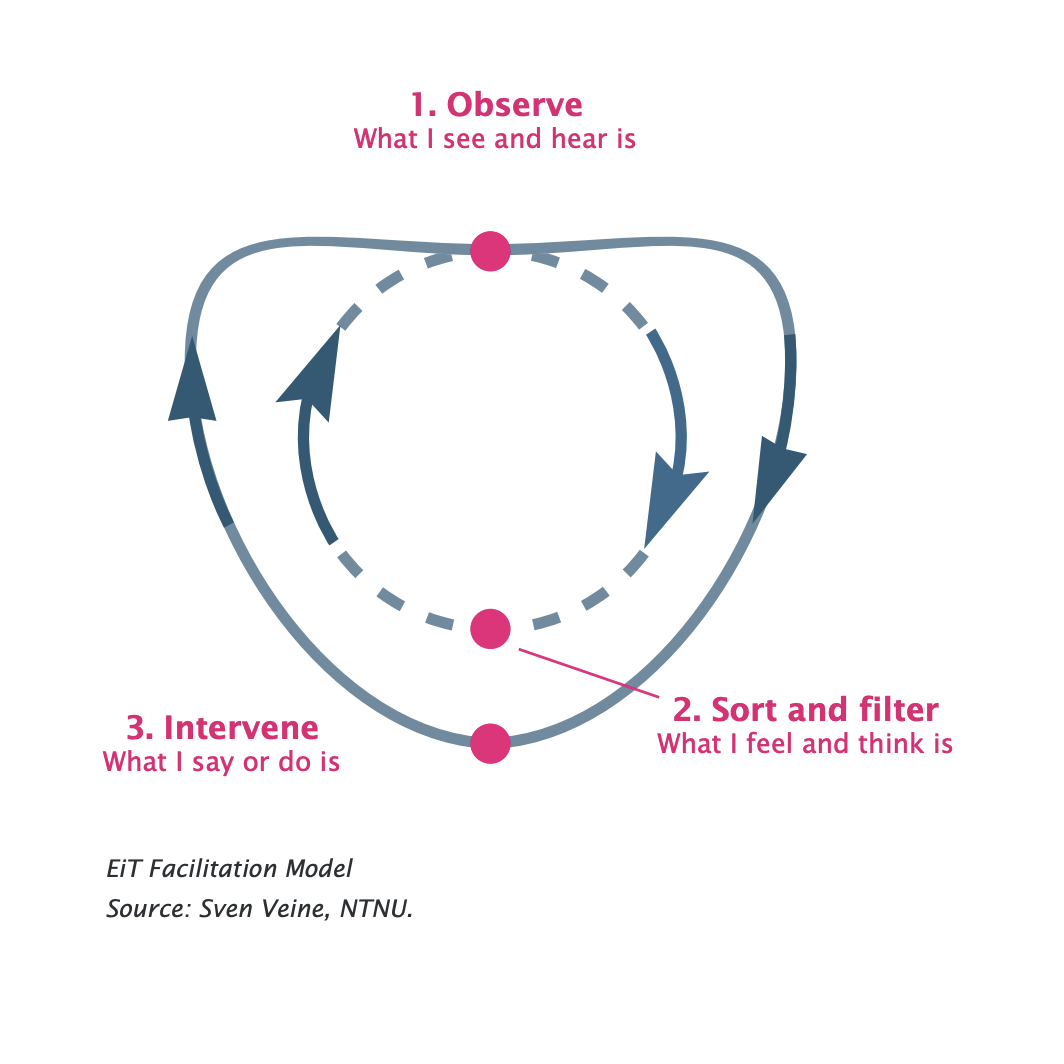
#7 EiT facilitation model
⏱ As long as needed or a predetermined period of for example 15 minutes.
𐀪 Most beneficially, two persons jointly facilitate the team. They observe and intervene and thereby help the team to reflect and discuss their process and cooperation.
❔ The observations must be as specific as possible. The facilitator should NOT include his / her own interpretation of the observations. As an example, the facilitator should not share what he/she thinks about certain team members who for example talk more than others. The basic rule of facilitation is to ask open questions- what, how, why - thus promoting a reflection and dialogue in the team. This should bring attention to the elements in the cooperation and process and hopefully to optimisation of the teamwork. The facilitator does not assess or evaluate.
background
The facilitation circle is a tool for the facilitator or team member when they facilitate teamwork. It is a step-by-step starting point forfacilitation. (Read more about BAAA’s facilitation in EiT at the end of this toolbook). The facilitation circle is the foundation for facilitation in EiT at BAAA and at NTNU in Trondheim.
purpose
The purpose of facilitating teamwork is to teach the participants how to work in teams and how they hopefully can optimise their teamwork. Through observations and interventions, the facilitator enables the team to stop and reflect upon what is going on in the team and the evolvement of certain mechanisms and processes. It brings awareness of the process and the elements of the teamwork.
procedure
The first step in the model is observation. The facilitator will switch between observing and sharing the observations with the team. The starting point is always: ”What I see and hear is … ..” The next step is to sort and filter the observations, and the facilitator’s thoughts and assumptions then form the intervention strategy. However, the facilitator’s subjective evaluation should NOT be shared with the team. The final level of the model is to intervene. The intervention sums up the observations.
An example: ”I have observed that some of the team members speak more than others. What is your experience?”
practical matters
Useful tools are sociograms, maps and other tools from the toolbook.
Example