#19 Design Thinking
⏱ 4-6 hours and in some cases even days or weeks
𐀪 4-6 people
❔ The Design Thinking process is usually conducted in a more flexible way than described here. This enables the team to move back and forth in the process, develop and test several different ideas and prototypes, so that the team moves in a BML (Build Measure Learn) loop. See the illustration under ”Idea Visualisation (prototyping).
background
Design Thinking is considered a strategy to create innovative products and services based on insights into human behaviour, technology and business opportunities. Design Thinking is especially suitable as an approach to solving complex problems where it is necessary to involve knowledge from many disciplines to illustrate the problem from many different angles. Therefore, Design Thinking is often used to frame an innovation process.
purpose
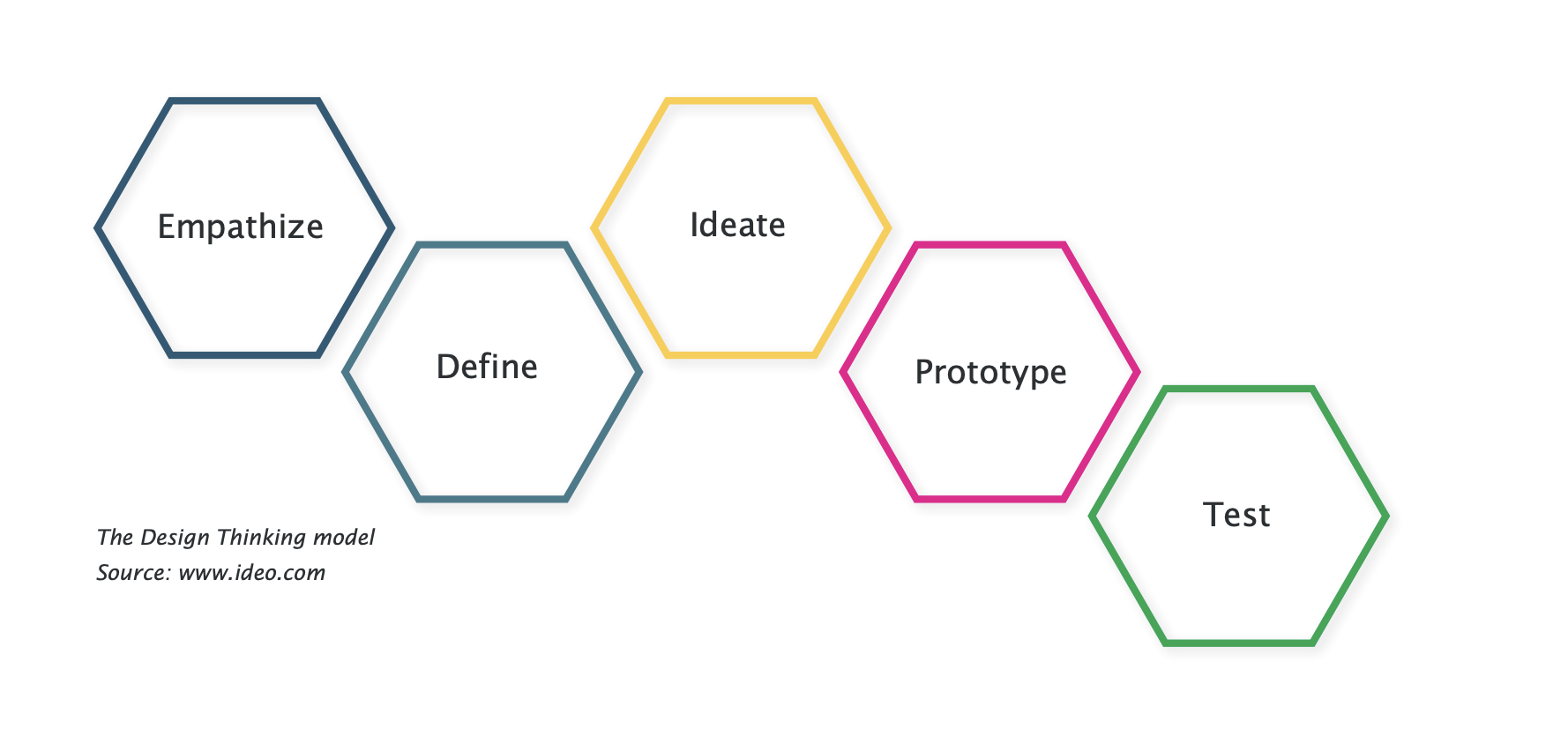
The purpose of using the Design Thinking model is to handle complex problems that are undefined or unknown. This is done through a step-by-step process that develops an understanding of needs within the problem, by reformulating the problem, by creating many ideas in brainstorming sessions and by having a practical approach to the development and testing of prototypes before deciding on the final product. The five phases of Design Thinking may provide an opportunity for solving more complex problems or challenges in an innovation context.
procedure
1. Empathize: Understand the context
The first phase is where you should get an understanding of the challenge the team is going to solve. This includes, among other things, contact with experts to find out more about the problem area or by observing, engaging in and embracing the users’ feelings and needs to understand their experiences and motivation in relation to the problem context. The team should disregard their own assumptions and perceptions of the problem area in order to get real and valid insight into the potential users and their needs. It often requires quite some information gathering.
2. Define: Define the problem (yellow zone)
In this phase, information is analysed to define the core issues in relation to the challenge. It concerns a clarification of the problem in a relatively wide context so that it is not driven by the team’s wishes. An example: ”Teenagers need nutritious food to thrive, be healthy and grow.” And not ”We’re going to sell more healthy food for teenagers”. The formulation of the problem should enable questions that
are open and wide enough to generate more and new solutions.
3. Ideate: Brainstorming (green zone)
The third phase concerns the generation of ideas based on the problem formulation and the gathered information. The team needs to create as many ideas as possible, reconsider the problem and try to think out of the box in order to identify possible solutions to the problem formulation. There are many useful brainstorming techniques. Finally, techniques or tools to test ideas should also be used.
4. Prototype: Create a prototype (green zone)
Phase four is about producing several low-tech and cheap versions of the idea or product, so the team can move forward with the idea. Prototypes can be shared and tested in the team or groups of customers. The purpose of this experimental phase is to identify the best ideas or the best solutions to the challenge. Prototype testing gives the team a better understanding of how the potential users or target groups will interact, think and feel about the product.
5. Test: Test the prototype
Inputs from this phase are subsequently used to select the final solution (red zone). What works best in relation to solving the challenge? What has the greatest market potential, etc. Then the process starts again.
practical matters
- Paper, pencils and post-it notes
- Online access to relevant databases relevant for the problem area and user needs. Materials for prototypes such as cardboard, glue and if possible access to a 3D printer or creative workshop.
further information
L. Bruce Archer was the first author to use the term ‘Design Thinking’ in his book ”Systematic Method for Designers” from 1965.
The Hasso-Plattner Institute of Design at Stanford University developed the five-phase Design Thinking model, which is the leading university in teaching Design Thinking.
example