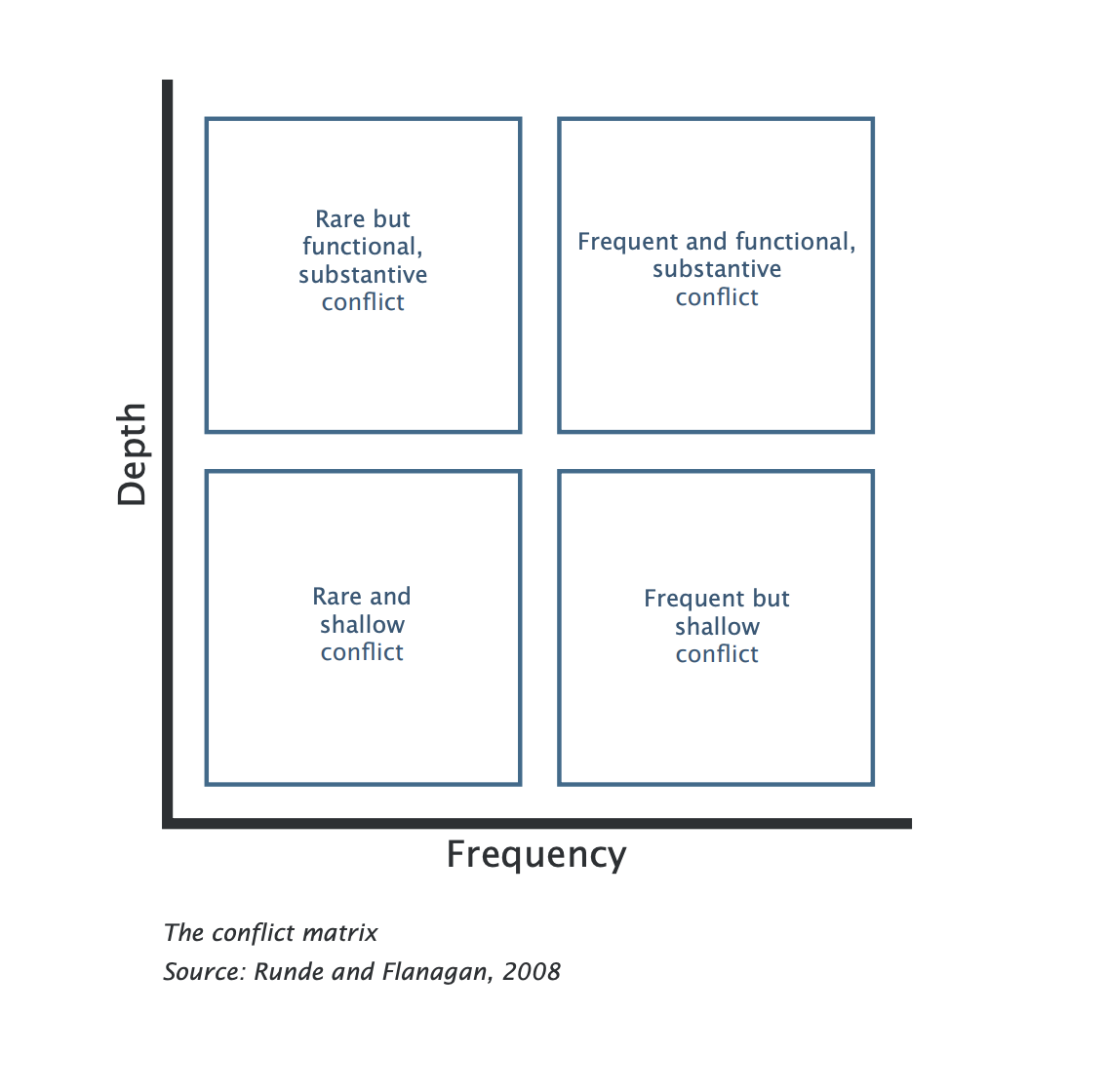
#12 The conflict matrix
⏱ Make sure to schedule enough time for the dialogue about the levels and placement of the team in the conflict matrix.
𐀪 4-6 people
❔ It is important to emphasise that there are no correct or incorrect answers. It solely concerns the team member’s perception of the frequency and depth of conflicts, and how the team members jointly advance to become a conflict-handling team.
background
The conflict matrix model is based on the assumption that conflicts in a team are both inevitable and desirable. Constructive conflicts promote top achievements, quality and creativity within the team.
However, conflicts in a team can be demotivating and lead to poor team performance and in worst case to the resolution of the team. Nonetheless, conflicts do not disappear or lessen because the team avoids conflicts. Therefore, the aim for the team should be to become a conflict-competent team.
purpose
The purpose of the tool is to practice the team’s ability to work with team dynamics and to handle conflicts. The team members should place their team in the model, discussing the depth and frequency of conflicts and looking at possible root causes of the conflicts (For example the five dysfunctions of a team or team operating model).
Then the team can become a more dynamic and constructive team. It promotes the
likelihood of optimal collaboration and good performance in the team.
procedure
The team decides where it should be placed in the matrix. In cases where a team is conflict competent, it is placed in the top right corner. In this square, the team’s ability to solve its conflicts in a positive way is high. This square reflects conflicts that are essential and fundamental to the team’s performance level. Hence, the team discusses and takes the temperature of the dynamics of the team.
It is a good idea to start by establishing knowledge about the typical causes of conflicts such as workload or the lack of understanding of roles. There may not be a clear and shared vision and specific goals. It may concern insufficient resources, conflicts due to status and overlapping competencies and interdependence (” I cannot get on with my work before you’ve solved your part”). It may also be a question of incompatible evaluation systems. This could be in situations where the team cannot deliver the desired quality before deadline or that it becomes too expensive to deliver on time.
Often, specific relationships in the team cause the conflicts. See for example the exercise with the five dysfunctions of a team that is useful together with the conflict matrix.
practical matters
It is the facilitator’s (or a team members) responsibility to make the team members consider what they learned from the exercise and what they need to be aware of in future and hence become a conflict competent team.
- Flipchart sheets
- Pencils
further information
The model was introduced at BAAA by Thomas Cook, A&D Resources, that specialises in assement and develpment of individuals, organisations and teams. Read more about conflict competent teams in the book ”Bulding Conflict Competent Teams” by Craig E. Runde and Tim A. Flanagan.
example