#10 Sociogram
⏱ Approx. 30 minutes
𐀪 4-6 people
❔ The learning outcome of this exercise is highest when the facilitator does not reveal what he or she has observed / drawn. However, it is important that the team knows and understands the sociogram and the purpose of the exercise. It is necessary for the team to discuss how to establish a great communicati- on environment that ensures that everyone has a say. A way to enable this is to select a chairperson who leads a discussion or by letting group members talk after turn, etc.
▷ Watch video on www.expertsinteams.org
background
Both research and practical experience show that communication within teams is crucial. Open, equal and straightforward communication ensures that good ideas are brought forward and that both the collaboration and the ability to solve problems are optimised. Communication within teams also means a lot to the individuals’ well-being. A sociogram is a visual way of illustrating how communication flows in a team.
purpose
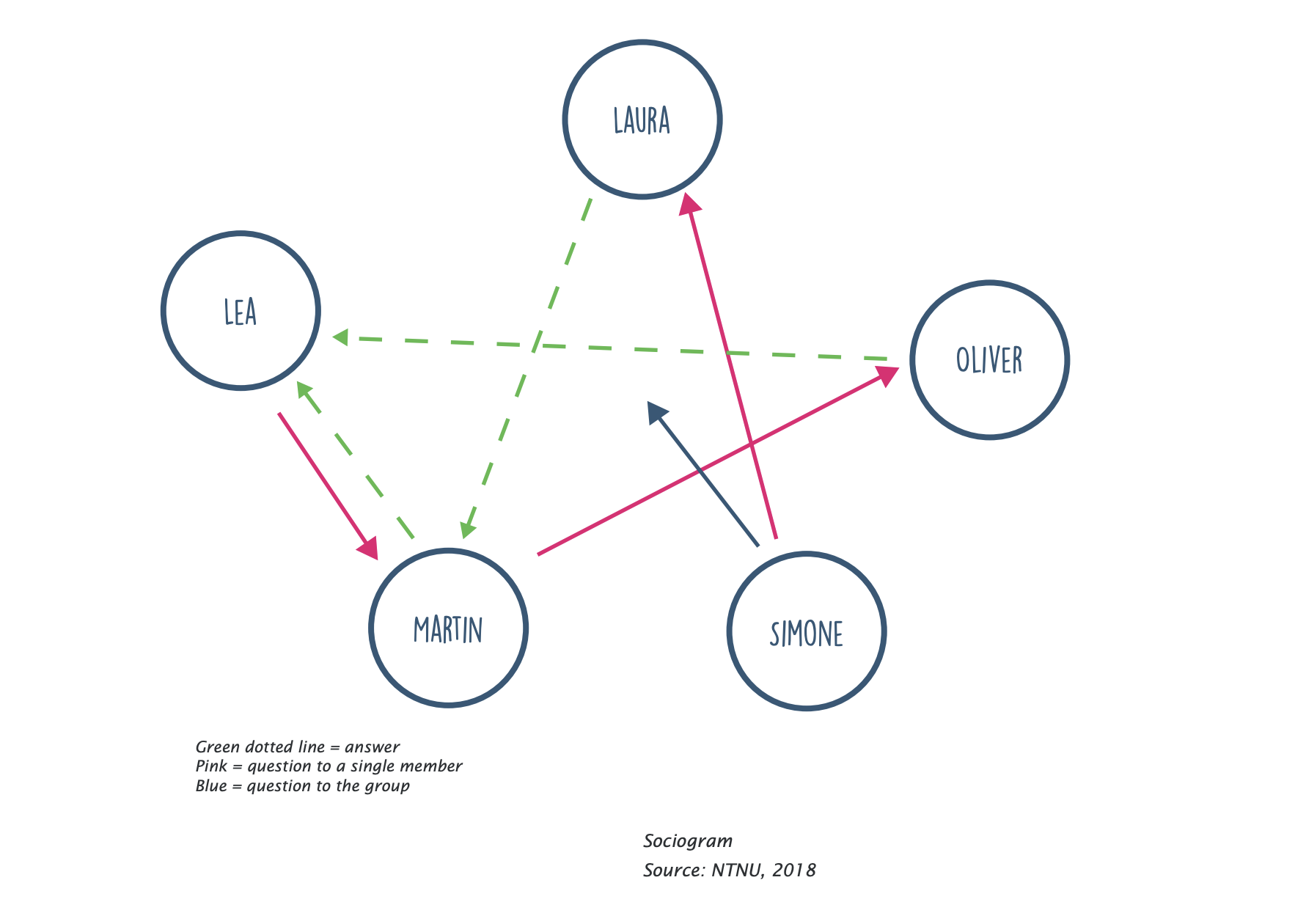
The purpose of the sociogram is to give the team a visual impression of the different communication aspects and flows in the team. A sociogram shows who participates in the team’s communication, who talks with whom, how long the different team members talk, how the question-answer pattern is, who asks the questions and who answers? It also shows which non-verbal communication patterns are present in the team such as eye contact, smiles and nodding.
procedure
The facilitator decides what to observe – the levels of observation
For example:
1. Who speaks and to whom
2. Who asks questions and who answers
3. How often or long does each team member speak
The facilitator writes the names of the team members in the sociogram and their location at the table. While the team works, discusses and talks and solves the task, the observer draws lines between the people who talk or have eye contact.
If a team member talks to the entire team, a line is drawn from the person to the middle of the sociogram. To observe who asks questions and who answers, lines of different colours are drawn. Red lines may for example symbolise questions and green lines the answers.
Use approximately 10 minutes to observe and draw the sociogram. Show the sociogram to the team with a short remark and open questions: “I have drawn this sociogram that maps the communication in the team. It tells how long the different team members speak, who speaks to whom and who asks questions, who answers etc.” The facilitator asks open questions such as ”What do you think the sociogram shows? What do you think about the dialogue and interaction in the team?” The team comments on the sociogram and discusses the patterns. The purpose of the exercise is to initiate reflection on the communication in the team.
practical matters
- Copies of the sociogram. Fill in with the name and placement of the team members at the table.
- Pencils in different colours.
further information
The sociogram is originally from Experts in Teams at NTNU, (Experts in teams, Handbook, 2018, p. 65), where it is still widely used.
example